Sunday, September 21, 2025

Pepper price today September 21, 2025


US reduces purchases, but China and UAE 'race' to skyrocket, pepper exports remain stable

Pepper prices today, September 21, 2025, are stable, the US reduced imports by 15.4%, but China increased by 47%, UAE increased by 31.6%. Vietnam's pepper exports remain stable, reaching 10,544 tons.

Báo Đà NẵngBáo Đà Nẵng20/09/2025

Pepper price today September 21, 2025 in the domestic market

Pepper prices today (September 20, 2025) in the Central Highlands and Southeast continue to remain stable, fluctuating from 147,000 - 150,000 VND/kg.

Dak Lak and Dak Nong are currently the two provinces with the highest prices, reaching 150,000 VND/kg. Next is Ba Ria - Vung Tau with 149,000 VND/kg.

Meanwhile, pepper prices in Gia Lai and Binh Phuoc today are at 147,000 VND/kg.

According to the price list, all provinces have not recorded any changes compared to yesterday. This stability is considered good news for farmers.
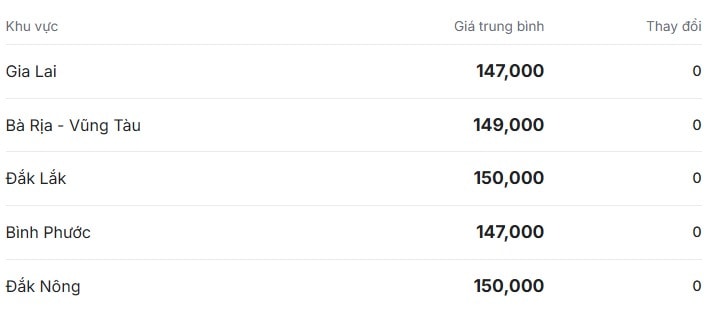
Pepper price today September 21, 2025 in the domestic market

Compared to the previous day, pepper prices in all provinces remained unchanged, reflecting the current state of the domestic market, with abundant supply from the harvest and stable export demand. This stability is considered a positive signal for farmers, helping them avoid the risk of sudden price fluctuations. However, domestic pepper prices are still affected by export prices and global supply, leading to a situation that shows no signs of a sharp increase in the short term.

According to experts and the Vietnam Pepper Association (VPSA), the pepper market is currently in a tug-of-war, with prices unlikely to increase sharply in the short term due to the lack of a real breakthrough in international demand. However, from late 2025 to early 2026, pepper prices are expected to increase thanks to a 10-15% decrease in global supply, low inventories, while demand is stable in major markets such as the US, Europe, China and India. As the world's number one exporter (accounting for over 55% of the global market share), Vietnam is expected to benefit greatly.

If the strategy of market diversification, improving processing quality and sustainable production is maintained, Vietnam's pepper price can reach 240,000 - 250,000 VND/kg. To achieve this, the industry needs to reduce dependence on traditional markets and focus more on quality, helping to strengthen its competitive position in the face of fluctuations in global supply and demand.

Pepper price today September 21 in the world market

At the end of the most recent trading session, the world pepper market witnessed stability in most commodities.

The price of Brazilian black pepper ASTA 570 remained stable at USD 6,600/ton. Similarly, the export price of Vietnamese black pepper remained unchanged, with the 500g/l grade reaching USD 6,600/ton and the 550g/l grade reaching USD 6,800/ton.

Malaysian ASTA black pepper price also remained stable at USD 9,700/ton.

On the contrary, Indonesian pepper prices have been adjusted. Specifically, Indonesian black pepper decreased by 0.48% to 7,027 USD/ton. At the same time, Indonesian Muntok white pepper also decreased by 0.49% to 9,957 USD/ton.

Meanwhile, Vietnamese white pepper remained unchanged at 9,250 USD/ton. Malaysian ASTA white pepper continued to move sideways at 12,900 USD/ton.

In the international market, pepper prices today (September 20, 2025) recorded stability in most commodities. The price of Brazilian black pepper ASTA 570 remained at 6,600 USD/ton, Vietnamese black pepper remained at 6,600 USD/ton (500 g/l) and 6,800 USD/ton (550 g/l), while Malaysian black pepper was stable at 9,700 USD/ton.

However, Indonesian Lampung black pepper and Muntok white pepper decreased slightly, reaching USD 7,027/ton and USD 9,957/ton, respectively. Vietnamese white pepper remained unchanged at USD 9,250/ton, while Malaysian pepper remained at USD 12,900/ton.
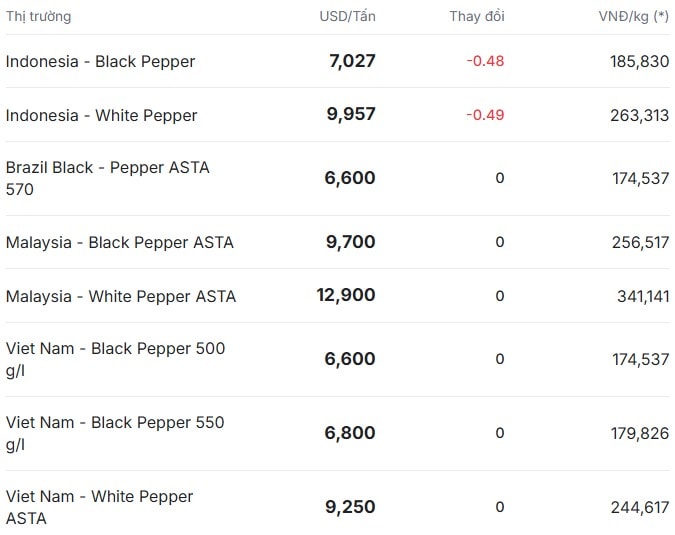
Pepper price today 9/21 in world market
Pepper price today September 21 in the world market

Regarding trade activities, Vietnam's pepper exports in the first 16 days of September 2025 reached 10,544 tons, with a turnover of 69.3 million USD, only slightly down compared to 10,830 tons (71.8 million USD) in the first 17 days of August. The US remained the largest market with 1,865 tons, although down 15.4%, while China increased sharply by 47% to 1,416 tons and the UAE increased by 31.6% to 1,034 tons.

This reflects market diversification, with Asia and the Middle East becoming increasingly important. In contrast, imports fell sharply to 998 tonnes (US$6.2 million), mainly from Cambodia, Brazil and Indonesia, as Vietnamese businesses prioritized domestic sources.

Source: https://baodanang.vn/gia-tieu-hom-nay-21-9-2025-my-giam-mua-nhung-trung-quoc-va-uae-dua-nhau-tang-vot-xuat-khau-tieu-van-vung-vang-3303266.html


Tuesday, September 16, 2025

Pepper Market September 16, 2025


Pepper Market September 16, 2025: Indonesia and Brazil both increased

Pepper prices in the domestic market today continued to move sideways at 148,000 - 151,000 VND/kg. In the world market, pepper prices from Indonesia and Brazil both increased in the last trading session.

Update pepper price

In the domestic market

Survey shows that pepper  prices   this morning in key production provinces continued to move sideways at 148,000 - 151,000 VND/kg.

Of which, Dak Lak and Dak Nong are recording the highest level of 151,000 VND/kg. Next are Ba Ria - Vung Tau and Dong Nai at 150,000 VND/kg, while Gia Lai and Binh Phuoc remain at a lower level of 148,000 VND/kg.

Market

(survey area)

Purchase price on September 16

(Unit: VND/kg)

Change from previous day (Unit: VND/kg)

Dak Lak

151,000

Gia Lai

148,000

Dak Nong

151,000

Ba Ria – Vung Tau

150,000

Binh Phuoc

148,000

Dong Nai

150,000

In the world market

At the end of the most recent trading session, the International Pepper Community (IPC) reported the price of Indonesian Lampung pepper at 7,101 USD/ton, up 0.38% (17 USD/ton) compared to the previous day.

In Brazil, the price of Brazilian black pepper ASTA 570 also increased by 1.54% (100 USD/ton), to 6,600 USD/ton.

Meanwhile, Malaysian ASTA black pepper continued to remain stable at USD 9,700/ton.

In Vietnam, the  export  price of black pepper  also remained unchanged at 6,600 - 6,800 USD/ton for 500 g/l and 550 g/l.

Type name

World black pepper price list

September 16 (Unit: USD/ton)

% change from previous day

Lampung Black Pepper (Indonesia)

7.101

+0.38

Brazilian Black Pepper ASTA 570

6,600

+1.54

Kuching Black Pepper (Malaysia) ASTA

9,700

Vietnamese black pepper (500 g/l)

6,600

Vietnamese black pepper (500 g/l)

6,800

At the same time of survey, Indonesian Muntok white pepper reached 10,062 USD/ton, up 38 USD/ton compared to the previous session.

Meanwhile, the price of Malaysian ASTA white pepper remained stable at 12,900 USD/ton and Vietnamese white pepper was 9,250 USD/ton.

Type name

World white pepper price list

September 16 (Unit: USD/ton)

% change from previous day

Muntok Indonesian White Pepper

10,062

+0.38

ASTA Malaysian White Pepper

12,900

Vietnam white pepper

9,250

Update pepper information

According to IPC, the pepper market in the second week of September continued to record mixed developments.

In India, pepper prices in both domestic and international markets declined. Meanwhile, in neighboring Sri Lanka, domestic pepper prices remained stable for three consecutive weeks.

Indonesian domestic and export pepper prices also remained stable last week, as most farmers in Belitung had completed their harvest.

In Malaysia, domestic black pepper prices increased, but white pepper prices decreased. The country's export prices were generally stable, without significant fluctuations.

In Vietnam, domestic pepper prices decreased but export prices increased. In Brazil, pepper prices continued to decrease, while prices of Cambodian black pepper and Chinese white pepper remained stable.

During the period from 2023 to May 2025, Belgium  imported   660 tons of pepper. The Netherlands was the largest supplier with 201 tons, followed by Germany, Vietnam, Spain and Madagascar.

According to VietnamBiz.vn


Monday, September 15, 2025

Promoting Vietnamese spice industry to US businesses


Promoting Vietnamese spice industry to US businesses

Ambassador Nguyen Quoc Dung emphasized that Vietnam is proud to be the third country in the world in supplying and processing spices, with an annual turnover of more than 1 billion USD.

Promoting Vietnamese Spice Industry to US Businesses
Vietnamese Ambassador to the United States Nguyen Quoc Dung delivered opening remarks at the event.

On September 10, the Embassy of Vietnam in the United States and the American Spice Trade Association (ASTA) co-organized the event "Opening New Horizons in Trade" at the Vietnam House, Washington DC.

The event aims to promote and introduce the Vietnamese spice industry to local businesses, and at the same time connect businesses of the two countries.

The event was attended by more than 100 member enterprises of ASTA, Cocoa Coffee Association and enterprises in the import-export sector of Vietnam, representatives of the US Chamber of Commerce, US-ASEAN Business Council, US Grains Council and trade and agricultural counselors of ASEAN embassies in the United States.

Speaking at the opening of the event, Ambassador Nguyen Quoc Dung emphasized that Vietnam is proud to be the third largest country in the world in supplying and processing spices, with an annual turnover of more than 1 billion USD (2024 data).

The spice industry is promoting green production, developing raw material areas that meet the standards of major markets, demonstrating a commitment to food safety and sustainable development.

2025 is also particularly meaningful as it marks the 30th anniversary of  Vietnam-US diplomatic relations , in which trade, including spices, is an important driving force.

The United States is currently one of the largest markets for Vietnamese spices, with pepper being the main product and increasing demand, opening up many cooperation opportunities for businesses of the two countries.

Promoting Vietnamese Spice Industry to US Businesses
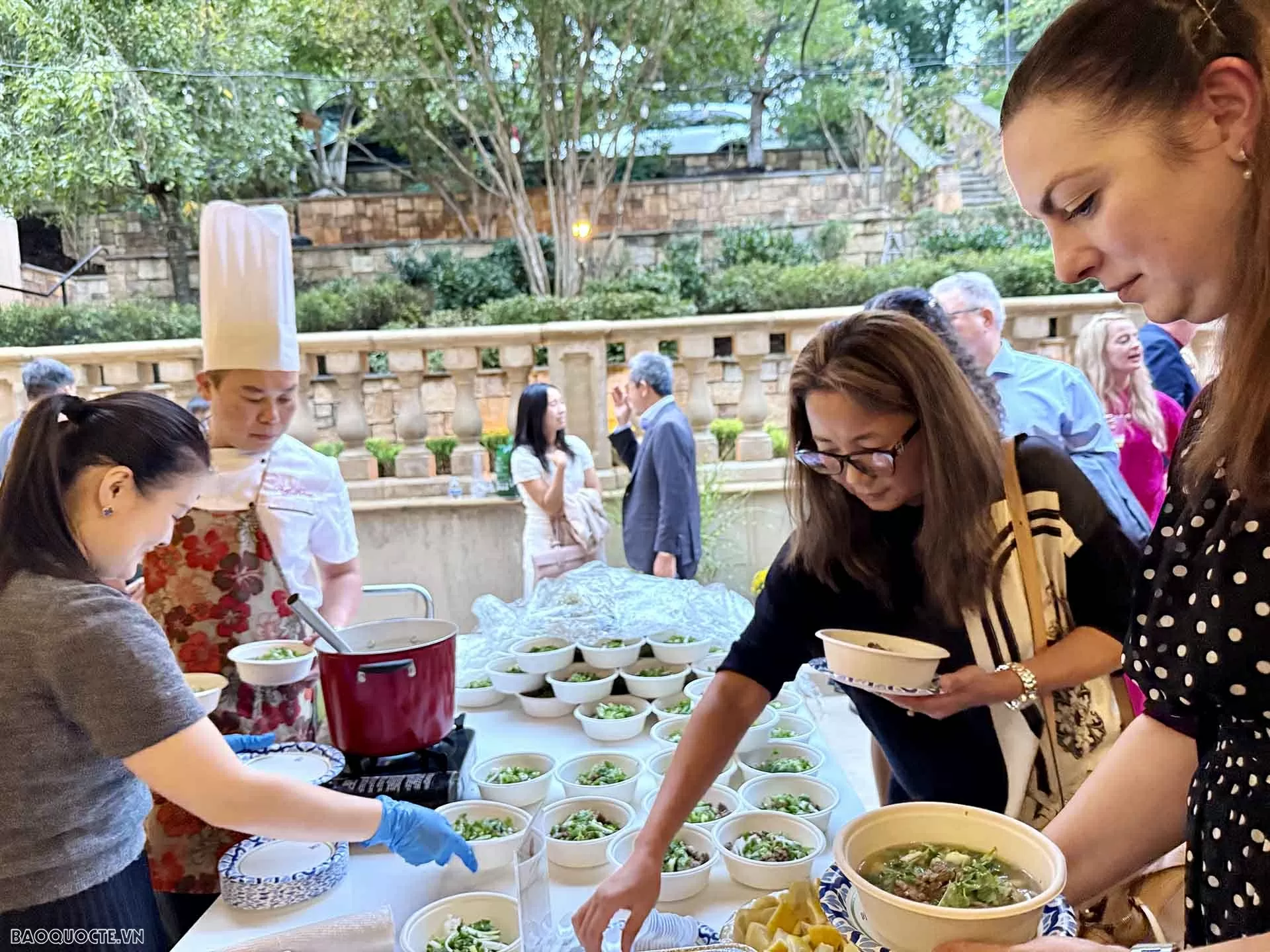
Guests enjoy Vietnamese pho at the event.

At the event, ASTA President Kerri Goad-Berrios thanked the Vietnamese Embassy for opening the Vietnam House for member businesses to exchange and connect with Vietnamese businesses and partners.

To help local businesses better understand the Vietnamese spice industry, the Vietnam Trade Office in the United States gave a presentation introducing an overview of the industry, prospects and cooperation opportunities.

At the same time, the Trade Office informed and invited US businesses to the Vietnam Spice and Pepper Outlook 2026 (VIPO) Conference organized by the Ministry of Agriculture and Environment in Da Nang from March 3-5, 2026.

Promoting Vietnamese Spice Industry to US Businesses
The Bac Bling singing and dancing performance attracted the attention of the attendees.

Attendees were impressed with traditional dishes using typical Vietnamese spices (beef pho, fried spring rolls, spring rolls...) and special music and dance performances at the event.

On this occasion, guests at the event received gifts from Tran Chau Group Corporation, a member of the Vietnam Pepper and Spice Association (VPSA), which are Vietnamese organic pepper and spices.


US market – 'new horizon' for Vietnam's spice industry

The United States is considered a 'new horizon' for Vietnam's spice industry. In the first 7 months of 2025, Vietnam exported nearly 35,700 tons of pepper, accounting for 78.6% of total US imports.

Global position of Vietnamese spices

In the volatile global trade picture,  the United States  has always been one of Vietnam's most important markets. Not only because of its huge and diverse purchasing power, but also because of its complementary trade structure and less direct competition.

For the spice industry, especially pepper and cinnamon, the US market is opening up a “new horizon”, both challenging and full of potential for Vietnamese businesses.

Sharing at the event “Opening new horizons in trade” held at the Vietnam House, Washington DC, Mr. Do  Ha Nam  - Chairman of the Vietnam Food Association, former Chairman of the Vietnam Pepper Association emphasized that Vietnam is currently the world’s largest pepper exporting country, accounting for over 50% of global output. Each year, Vietnam exports about 80,000 tons to the United States, accounting for 60% of the total pepper imports of this market.

Along with pepper, cinnamon and star anise are also making a strong impression. Vietnamese cinnamon currently accounts for 50.6% of the global export market share. Vietnamese spice products are present in more than 120 countries, of which the United States, Europe and China are key markets.

Mr. Do Ngoc Hung - Commercial Counselor, Head of the Vietnam Trade Office in the United States also said that Vietnam's spice export turnover in 2024 will reach more than 1 billion USD, an increase of 41% compared to the previous year and accounting for 11% of the global market share. In particular, pepper has maintained its "champion" position for two decades, accounting for 35% of global output and 55% of global export turnover.

In the first 7 months of 2025, Vietnam exported nearly 35,700 tons of pepper to the United States, accounting for 78.6% of the country's total pepper imports.

Although pepper exports showed signs of decline in the first eight months of the year, the overall trend remained stable, despite trade fluctuations. What is particularly important is that the United States does not produce pepper at all. This market is therefore completely dependent on imports, opening up a sustainable and long-term space for Vietnamese businesses. Therefore, despite short-term difficulties, the United States remains a key market for the Vietnamese spice industry.

Challenges from quality standards and competition

Great opportunities come with great challenges. The US market is famous for its strictness in terms of quality, food safety, traceability and sustainability. Therefore, to maintain its position, Vietnamese enterprises not only need to increase output but, more importantly, invest in quality, green production, and develop raw material areas that meet international standards.

In addition, competition from other exporting countries is also increasingly fierce. Vietnamese enterprises need to affirm their advantages through competitive prices and diverse designs, while at the same time improving their ability to adapt to market fluctuations, from  exchange rates  to trade policies.

Faced with new demands, the Vietnamese spice industry has proactively changed direction. Businesses and associations are promoting green production, expanding clean raw material areas, and meeting international standards. This is not only a mandatory requirement to penetrate deeply into the US market, but also an inevitable trend for sustainable development.

Along with production, trade promotion plays a key role. The Vietnam Trade Office in the United States recommends that businesses actively participate in fairs and exhibitions, and take advantage of promotional channels to connect directly with local importers and distributors. Events such as “Opening new horizons in trade” have proven to be effective in enhancing the image and brand of Vietnamese spices.

Mr. Do Ngoc Hung suggested that in order for Vietnamese spices to continue to stand firm, businesses need to develop a more systematic approach strategy. Large businesses must proactively use resources, invest in improving overall competitiveness, apply innovation and strictly comply with rules of origin. Small and medium-sized businesses should strengthen their connections with industry associations, the Ministry of Industry and Trade and the Trade Office to receive timely support in terms of information and direction.

In particular, Trade Counselor Do Ngoc Hung said that it is necessary to fully exploit the benefits from new generation FTAs, diversify export markets to reduce risks, and avoid dependence on a few main markets. This will help Vietnamese spices not only maintain, but also expand their position in the context of global competition.

From pepper – the “black gold” of Vietnamese agriculture to cinnamon, star anise and many other products… Vietnamese spices are asserting their important role on the dining table and in the global supply chain.

Challenges remain, but opportunities are more open than ever. With the support of the Government, the Ministry of Industry and Trade, the trade system and especially the initiative of businesses, Vietnamese spices can completely conquer the US market, not only by output but also by quality, brand and sustainability.


Pepper Market September 15, 2025: Stable, wide open opportunities in the US market

Pepper prices in the domestic market today  remained stable at 148,000 - 151,000 VND/kg. According to the Vietnam Trade Office in the US, the US currently cannot produce pepper at all and must rely entirely on imports, which opens up a sustainable and long-term space for Vietnamese businesses.

Update pepper price

In the domestic market

According to a survey,  pepper prices  this morning in key producing provinces and cities were stable at around 148,000 - 151,000 VND/kg, unchanged from the previous day.

Of which, Dak Lak and Dak Nong are recording the highest level of 151,000 VND/kg. Next are Ba Ria - Vung Tau and Dong Nai at 150,000 VND/kg, while Gia Lai and Binh Phuoc remain at a lower level of 148,000 VND/kg.

Market

(survey area)

Purchase price on September 15

(Unit: VND/kg)

Change from previous day (Unit: VND/kg)

Dak Lak

151,000

Gia Lai

148,000

Dak Nong

151,000

Ba Ria – Vung Tau

150,000

Binh Phuoc

148,000

Dong Nai

150,000

In the world market

In the world market, the International Pepper Community (IPC) quoted the highest  price of   Malaysian ASTA black pepper at 9,700 USD/ton. Next was Indonesian Lampung pepper at 7,074 USD/ton, while Brazilian ASTA 570 black pepper was at the lowest price of 6,500 USD/ton.

In Vietnam, the  export  price of black pepper  is currently maintained at around 6,600 - 6,800 USD/ton for 500 g/l and 550 g/l.

Type name

World black pepper price list

September 15 (Unit: USD/ton)

% change from previous day

Lampung Black Pepper (Indonesia)

7,074

Brazilian Black Pepper ASTA 570

6,500

Kuching Black Pepper (Malaysia) ASTA

9,700

Vietnamese black pepper (500 g/l)

6,600

Vietnamese black pepper (500 g/l)

6,800

At the same time of survey, the price of Malaysian ASTA white pepper reached 12,900 USD/ton, Indonesian Muntok white pepper was 10,024 USD/ton and Vietnamese white pepper was at 9,250 USD/ton.

Type name

World white pepper price list

September 15 (Unit: USD/ton)

% change from previous day

Muntok Indonesian White Pepper

10,024

ASTA Malaysian White Pepper

12,900

Vietnam white pepper

9,250

Update pepper information

According to  the Industry and Trade Newspaper , at the event "Opening new horizons in trade" held at the Vietnam House, Washington DC, Mr. Do Ngoc Hung - Commercial Counselor, Head of the Vietnam Trade Office in the US said that Vietnam's spice export turnover in 2024 will reach more than 1 billion USD, an increase of 41% compared to the previous year and accounting for 11% of the global market share. In particular, pepper has maintained its "champion" position for two decades, accounting for 35% of global output and 55% of global export turnover.

In the first 7 months of 2025, Vietnam exported nearly 35,700 tons of pepper to the US, accounting for 78.6% of  the country's total pepper  imports  .

Although pepper exports have shown signs of decline in the first eight months of the year, the overall trend remains stable, despite trade fluctuations. What is particularly important is that the US does not produce pepper at all. This market is therefore completely dependent on imports, opening up a sustainable and long-term space for Vietnamese businesses. Therefore, despite short-term difficulties, the US remains a key market for the Vietnamese spice industry.

Great opportunities come with great challenges. The US market is famous for its strictness in terms of quality, food safety, traceability and sustainability. Therefore, to maintain its position, Vietnamese enterprises not only need to increase output but, more importantly, invest in quality, green production, and develop raw material areas that meet international standards.

In addition, competition from other exporting countries is also increasingly fierce. Vietnamese enterprises need to affirm their advantages through competitive prices and diverse designs, while at the same time improving their ability to adapt to market fluctuations, from exchange rates to trade policies.

Faced with new requirements, the Vietnamese spice industry has proactively changed direction. Businesses and associations are promoting green production, expanding clean raw material areas, and meeting international standards. This is not only a mandatory requirement to penetrate deeply into the US market, but also an inevitable trend for sustainable development.

Along with production, trade promotion plays a key role. The Vietnam Trade Office in the US recommends that businesses actively participate in fairs and exhibitions, and take advantage of promotional channels to connect directly with local importers and distributors. Events such as “Opening new horizons in trade” have proven to be effective in enhancing the image and brand of Vietnamese spices.

Mr. Do Ngoc Hung suggested that in order for Vietnamese spices to continue to stand firm, businesses need to develop a more systematic approach strategy. Large businesses must proactively use resources, invest in improving overall competitiveness, apply innovation and strictly comply with rules of origin. Small and medium-sized businesses should strengthen their connections with industry associations, the Ministry of Industry and Trade and the Trade Office to receive timely support in terms of information and direction.

In particular, Trade Counselor Do Ngoc Hung said that it is necessary to fully exploit the benefits from new generation FTAs, diversify export markets to reduce risks, and avoid dependence on a few main markets. This will help Vietnamese spices not only maintain, but also expand their position in the context of global competition.

Challenges remain, but opportunities are more open than ever. With the support of the Government, the Ministry of Industry and Trade, the trade system and especially the initiative of businesses, Vietnamese spices can completely conquer the US market, not only by output but also by quality, brand and sustainability.


Sunday, September 14, 2025

Pepper Exports Soar to $1 Billion


Pepper Exports Soar to $1 Billion, Hitting a Seven-Year High in Global Markets

Pepper
Reading Time: 2 minutes

Vietnam’s pepper industry is experiencing a remarkable resurgence, driven by robust global demand and a tightening supply chain that has propelled export prices to new heights, according to the Vietnam Pepper and Spice Association (VPSA). In August, Vietnam exported 21,464 tons of pepper, generating $139.8 million in revenue. This marked a 2.6% increase in volume and a 1.7% increase in value compared to July.

Year-on-year comparisons show even stronger growth: export volume surged by 10.6% and earnings soared by 19.5%. From January to August 2023, Vietnam exported a total of 166,510 tons of pepper, comprising 142,627 tons of

 black pepper and 23,883 tons of white pepper. While overall volume dipped by 9.4% compared to last year, this decline was more than offset by rising prices, with the average export prices reaching $6,666 per ton for black pepper and $8,732 per ton for white pepper—an impressive 41.5% and 38% increase, respectively.

The United States continues to be the largest market for Vietnamese pepper, despite a 31% decrease in shipments to 35,697 tons, accounting for 21.4% of the country’s total pepper export value. In contrast, exports to China have soared by 58% year-on-year, totaling 13,282 tons. Sales to the UAE and India also showed strong growth, rising by 9.7% and 13.7%, respectively. It’s an impressive balancing act, proving that while some doors may close, others swing wide open.

On the flip side, Vietnam has ramped up its pepper imports, bringing in 34,524 tons valued at $215.3 million, which represents a staggering 61.7% increase in volume and a striking 143.5% spike in value from the previous year. Brazil remains the top supplier, sending over 17,500 tons, followed by Cambodia and Indonesia.

Domestically, pepper prices have been on the rise since late August, with farm-gate prices climbing from VND142,000-143,000 (approximately $5.4) per kilogram to VND154,000-155,000 by early September before settling around VND152,000-153,000. VPSA attributes this price rise to dwindling on-farm stocks as the harvest season came to a close and a surge in demand from exporters.

Looking ahead, industry experts predict that limited supply will sustain high prices in the near term. This is especially pertinent as Vietnamese exporters strategize to cut back on importing raw pepper for processing and re-export to the U.S. in light of the reciprocal tariffs that can reach up to 40% on transshipped goods.

Questions & Answers

How did Vietnam’s pepper exports perform in August 2023 compared to previous months?
In August 2023, Vietnam exported 21,464 tons of pepper worth $139.8 million, reflecting a 2.6% increase in volume and a 1.7% rise in value from July.

What factors have contributed to the rising prices of Vietnamese pepper?
Rising prices are attributed to dwindling on-farm stocks after harvest and strong demand from exporters, particularly as global supply tightens.

Which countries are the primary markets for Vietnam’s pepper exports?
The United States remains the largest market, despite a 31% drop in shipments, while exports to China surged by 58%, indicating shifting dynamics in the demand for Vietnamese pepper.


Vietnam’s pepper industry is experiencing a remarkable resurgence, driven by robust global demand and a tightening supply chain that has propelled export prices to new heights, according to the Vietnam Pepper and Spice Association (VPSA). In August, Vietnam exported 21,464 tons of pepper, generating $139.8 million in revenue. This marked a 2.6% increase in volume and a 1.7% increase in value compared to July.

Year-on-year comparisons show even stronger growth: export volume surged by 10.6% and earnings soared by 19.5%. From January to August 2023, Vietnam exported a total of 166,510 tons of pepper, comprising 142,627 tons of black pepper and 23,883 tons of white pepper. While overall volume dipped by 9.4% compared to last year, this decline was more than offset by rising prices, with the average export prices reaching $6,666 per ton for black pepper and $8,732 per ton for white pepper—an impressive 41.5% and 38% increase, respectively.

The United States continues to be the largest market for Vietnamese pepper, despite a 31% decrease in shipments to 35,697 tons, accounting for 21.4% of the country’s total pepper export value. In contrast, exports to China have soared by 58% year-on-year, totaling 13,282 tons. Sales to the UAE and India also showed strong growth, rising by 9.7% and 13.7%, respectively. It’s an impressive balancing act, proving that while some doors may close, others swing wide open.

On the flip side, Vietnam has ramped up its pepper imports, bringing in 34,524 tons valued at $215.3 million, which represents a staggering 61.7% increase in volume and a striking 143.5% spike in value from the previous year. Brazil remains the top supplier, sending over 17,500 tons, followed by Cambodia and Indonesia.

Domestically, pepper prices have been on the rise since late August, with farm-gate prices climbing from VND142,000-143,000 (approximately $5.4) per kilogram to VND154,000-155,000 by early September before settling around VND152,000-153,000. VPSA attributes this price rise to dwindling on-farm stocks as the harvest season came to a close and a surge in demand from exporters.

Looking ahead, industry experts predict that limited supply will sustain high prices in the near term. This is especially pertinent as Vietnamese exporters strategize to cut back on importing raw pepper for processing and re-export to the U.S. in light of the reciprocal tariffs that can reach up to 40% on transshipped goods.

Questions & Answers

How did Vietnam’s pepper exports perform in August 2023 compared to previous months?
In August 2023, Vietnam exported 21,464 tons of pepper worth $139.8 million, reflecting a 2.6% increase in volume and a 1.7% rise in value from July.

What factors have contributed to the rising prices of Vietnamese pepper?
Rising prices are attributed to dwindling on-farm stocks after harvest and strong demand from exporters, particularly as global supply tightens.

Which countries are the primary markets for Vietnam’s pepper exports?
The United States remains the largest market, despite a 31% drop in shipments, while exports to China surged by 58%, indicating shifting dynamics in the demand for Vietnamese pepper.


Saturday, September 06, 2025

Pepper Market September 5, 2025


Price temporarily stable

Pepper prices in the domestic market today are still fluctuating at 152,000 - 153,000 VND/kg. In the world market, pepper prices in all countries are generally stable, except for Indonesia which continues to decrease.

In the world market

At the end of the most recent trading session, the International Pepper Community (IPC) listed the price of Indonesian Lampung black pepper at 7,093 USD/ton, continuing to decrease slightly by 3 USD/ton compared to the previous day.

In other leading producing countries, prices were largely flat. Currently, Brazilian black pepper ASTA 570 is quoted at $6,650/ton, while Malaysian black pepper ASTA is at $9,700/ton.

In Vietnam, black pepper  export  prices  remained stable at 6,240 - 6,370 USD/ton for 500 g/l and 550 g/l.

Type name

World black pepper price list

September 5 (Unit: USD/ton)

% change from previous day

Lampung Black Pepper (Indonesia)

7,093

-0.04

Brazilian Black Pepper ASTA 570

6,650

Kuching Black Pepper (Malaysia) ASTA

9,700

Vietnamese black pepper (500 g/l)

6,240

Vietnamese black pepper (500 g/l)

6,370

At the same time of survey, the price of Indonesian Muntok white pepper reached 10,051 USD/ton, slightly down 3 USD/ton compared to the previous day. While Vietnam's exported white pepper remained unchanged at 9,150 USD/ton, Malaysian ASTA white pepper reached 12,900 USD/ton.

Type name

World white pepper price list

September 5 (Unit: USD/ton)

% change from previous day

Muntok Indonesian White Pepper

10,051

-0.03

ASTA Malaysian White Pepper

12,900

Vietnam white pepper

9,150

Update pepper information

According to   Nguoi Lao Dong  Newspaper , explaining the recent sharp increase in pepper prices, a member of the Vietnam Pepper and Spice Association (VPSA) said that pepper prices increased because it was the end of the season.

Vietnam pepper harvest ended in May 2025 and most small-scale farmers sold their products because they could not keep them. Only large-scale, wealthy farmers kept their products and sold them in batches.

“The goods that businesses need to buy to deliver signed orders are running out, so the price must increase. An important factor is that the US applies a 40% transfer tax, so businesses also limit pepper  imports   for processing and export because it is not profitable,” this member informed.

Statistics show that at the beginning of the year, Vietnamese enterprises imported 3,000 - 4,000 tons of Brazilian pepper per month, but now they only import about 1,000 tons per month, so they have to increase domestic pepper purchases. Therefore, in the short term, pepper prices will continue to increase because enterprises have to buy goods and fulfill signed orders.

According to this source, in the first 8 months of 2025, pepper exports will surpass the 1 billion USD mark, the highest since 2018 but still not equal to the golden period of 2015-2016.

The Ministry of Agriculture and Environment said that in the first 8 months of 2025, Vietnam's agricultural, forestry and fishery exports continued to maintain positive growth momentum in many product groups and markets.

Of which, pepper exports in August 2025 are estimated at 21 thousand tons, worth 126.8 million USD, down 2.3% in volume and 10.8% in value compared to the previous month, but up 8.1% in volume and 8.6% in value compared to the same period last year.

In the first 8 months, total exports reached 165.7 thousand tons, worth 1.12 billion USD, down 9.8% in volume but up 26.9% in value. The average pepper export price reached 6,739.7 USD/ton, up sharply by 40.7%.

According to VietnamBiz.vn